Sailboat Retrospective Template
A metaphorical retro format where the team is a sailboat — Anchors hold you back, Wind pushes you forward, and Rocks are risks to navigate around.

See it in action
Drag cards between columns to try the format. Vote on items to see what surfaces.
What's slowing the team down? Processes, tools, technical debt, or friction points.
Manual deployment process — 45 minutes of click-ops
Legacy monolith — every change touches too many files
Unclear product requirements arriving mid-sprint
What's accelerating progress? Tools, practices, people, or momentum that helps the team.
New CI/CD pipeline is saving us 2 hours per deploy
Team is motivated after shipping the big feature
Pair programming is catching bugs earlier
What risks lie ahead? Upcoming deadlines, dependencies, or uncertainties.
PCI compliance audit coming up — need to prepare
Two team members are on PTO overlapping next week
Production DB migration scheduled for next sprint
How to run it
Sailboat takes about 20–30 min. Here's the flow.
Set the scene
Explain the sailboat metaphor: Wind (tailwinds), Anchors (drag), Rocks (risks). Draw a simple boat on the board.
Add cards
Team adds cards to each column. Encourage cards for all three categories — don't let Anchors dominate.
Vote
Vote on the heaviest anchors, strongest winds, and sharpest rocks. Prioritize what's most impactful.
Navigate
Discuss how to cut the top anchors, maximize the top winds, and steer around the top rocks. Assign actions.
Summary
Recap the top actions and relate them back to the metaphor. Assign owners for each navigation item.
- ✓Draw a literal sailboat on the board or use LetRetro's illustrated template.
- ✓Keep the metaphor alive during discussion — 'how do we cut this anchor?' vs 'how do we fix this?'
- ✓Vote separately within each category — don't compare anchors to rocks directly.
- ✓Wind items are often the easiest to action — double down on what's working.
- ✓Review previous sprint's rocks — did they materialize? How did you navigate?
- ✓Use the metaphor in team chat throughout the sprint ('this bug is an anchor').
- ✗Letting Anchors dominate the conversation — Wind deserves equal time.
- ✗Forgetting about Rocks entirely — they're the most strategic column.
- ✗Taking the metaphor too literally — it's a tool, not the retro itself.
- ✗Not assigning actions — metaphors without action items are just stories.
- ✗Reusing the same anchors sprint after sprint — escalate recurring anchors to leadership.
- ✗Running Sailboat every sprint — try alternating with a faster format like Start/Stop/Continue.
What is a Sailboat retrospective?
The Sailboat retrospective (also known as the Sailboat exercise or Speedboat) is one of the most creative and engaging Agile retrospective formats. It uses a simple metaphor: your team is a sailboat navigating toward your goals. The Wind fills your sails and pushes you forward. The Anchors drag behind and slow you down. The Rocks are risks ahead that you need to navigate around.
This metaphor-based format originated from the Agile coaching community, where practitioners found that abstract process discussions often failed to engage teams. By framing the retro as a journey, Sailboat makes improvement feel like an adventure rather than a chore. The format was popularized in the Agile Retrospectives book by Esther Derby and Diana Larsen, and has since become a staple of engineering team retrospectives worldwide.
The psychological power of the Sailboat metaphor is twofold. First, it externalizes problems — an anchor dragging behind the boat is easier to discuss than a teammate who isn't pulling their weight. Second, it naturally frames solutions as forward motion — cutting an anchor or steering around a rock feels proactive rather than punitive. This reframing is especially valuable for teams that struggle with blameless retrospectives.
Similar templates
If you like Sailboat, you might also enjoy these formats.

Mountain Climb
A forward-looking retrospective format that helps goal-oriented teams reflect on progress, identify blockers, and plan the next sprint like climbing a mountain.
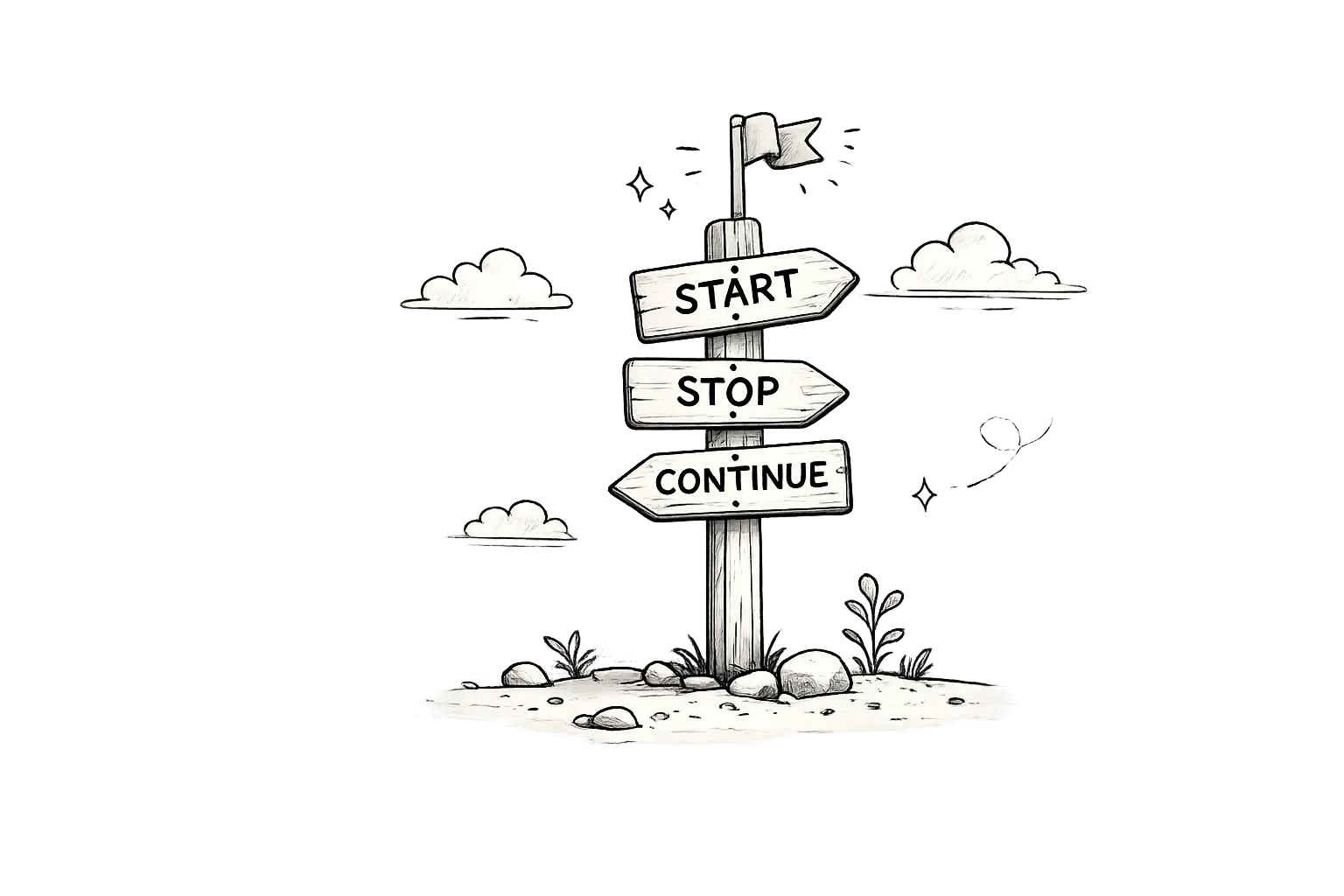
Start/Stop/Continue
A classic three-column retro format that helps teams identify new practices to adopt, unhelpful habits to drop, and winning behaviors to reinforce.

DAKI
A four-column continuous improvement format — Drop, Add, Keep, Improve — that combines Start/Stop/Continue simplicity with actionable improvement granularity.

Stoplight
An intuitive traffic-light retro format — Red for blockers, Yellow for caution, Green for smooth sailing — that makes team health instantly visible at a glance.
Frequently asked questions
What is a Sailboat retrospective?
Sailboat is a metaphor-based retrospective where the team imagines itself as a sailboat. Anchors are what slow you down, Wind is what pushes you forward, and Rocks are risks ahead.
How is Sailboat different from Mountain Climb?
Mountain Climb is forward-looking and goal-oriented. Sailboat is more about identifying current impediments (Anchors), accelerators (Wind), and risks (Rocks) — it's more diagnostic.
How long should a Sailboat retro take?
20–30 minutes. The metaphor makes it engaging, but don't let creative discussion extend the timeline.
Can I run Sailboat asynchronously?
Yes — LetRetro supports async Sailboat boards where team members add anchors, wind, and rocks throughout the sprint, then vote and discuss at retro time.
Is Sailboat good for remote teams?
Extremely. The metaphor is universally understood and requires no special context. Remote team members can easily contribute to all three columns.
What if my team finds the metaphor silly?
Some teams prefer direct formats like Start/Stop/Continue. If the metaphor isn't landing, switch to a literal format — the goal is honest reflection, not clever framing.
Run your sailboat retro
Free forever plan. Start running better retrospectives in under 2 minutes.
Get Started Free