DAKI Retrospective Template
A four-column continuous improvement format — Drop, Add, Keep, Improve — that combines Start/Stop/Continue simplicity with actionable improvement granularity.

See it in action
Drag cards between columns to try the format. Vote on items to see what surfaces.
What should the team stop doing? Activities, meetings, or processes that create waste.
Weekly status email — duplicated in standup and Slack
Cross-team sync meeting that could be a Slack message
Estimation poker for tickets under 3 points
What new practices or tools should the team adopt? Innovation and new capabilities.
Automated performance regression tests in CI
Shared on-call rotation document
Monthly tech debt reduction sprint
What's working well that should become a team standard? Reinforce and document.
Bi-weekly demos — stakeholders love them
Daily standup — 15 min, focused, on time
What existing processes need refinement? Make good practices better.
Code review turnaround — aim for same-day feedback
Deploy process — add automated rollback
Sprint planning — add capacity for unexpected work
How to run it
DAKI takes about 20–30 min. Here's the flow.
Introduce DAKI
Explain the four columns. Emphasize that Improve is about making existing processes better, not replacing them.
Add cards
Team adds cards to all four columns. Encourage at least two per column.
Vote and cluster
Group related cards and vote. Drop and Improve often generate the most discussion.
Discuss
Discuss top items in each column. Spend extra time on Improve — it's the most nuanced column.
Commit to actions
Pick 1-2 items from Drop and 2-3 from Improve. Assign owners and deadlines.
- ✓Spend the most time on Improve — it's where incremental excellence happens.
- ✓Track Drop items across sprints — if the same item appears in multiple Drops, escalate it.
- ✓Keep items should be documented as team working agreements.
- ✓Improve items should have measurable targets — 'improve code review turnaround from 24h to 12h.'
- ✓Don't let Add overwhelm the team — cap additions at 2 per sprint.
- ✓Review last sprint's Add commitments first — did they actually get added?
- ✗Treating Drop and Add as the only columns that matter — Keep and Improve are equally important.
- ✗Letting Improve become a dumping ground for minor complaints — be specific.
- ✗Adding too many new practices at once — team change fatigue is real.
- ✗Using Drop to criticize individuals — it's about processes, not people.
- ✗Not documenting Keep items — they represent your team's agreed culture.
- ✗Skipping the review of previous sprint's actions.
What is a DAKI retrospective?
The DAKI retrospective — Drop, Add, Keep, Improve — is a powerful evolution of the classic Start/Stop/Continue format. By adding an explicit Improve column, DAKI creates space for incremental refinement of existing practices rather than the binary start/stop decision.
DAKI emerged from the Continuous Improvement movement in software engineering, where teams recognized that many processes don't need to be started or stopped — they need to be improved. A daily standup doesn't need to be dropped, but it could be improved. Code review doesn't need to be started from scratch, but the existing process could be improved. This nuance is what makes DAKI more sophisticated than simpler formats.
The psychological framework of DAKI is based on Kaizen — the Japanese philosophy of continuous, incremental improvement. The Drop column represents waste elimination (Muda in Lean terminology). The Add column represents innovation and new capabilities. The Keep column represents standardization — identifying what's working that should become a team norm. The Improve column represents Kaizen itself — the ongoing refinement that drives team excellence.
Similar templates
If you like DAKI, you might also enjoy these formats.
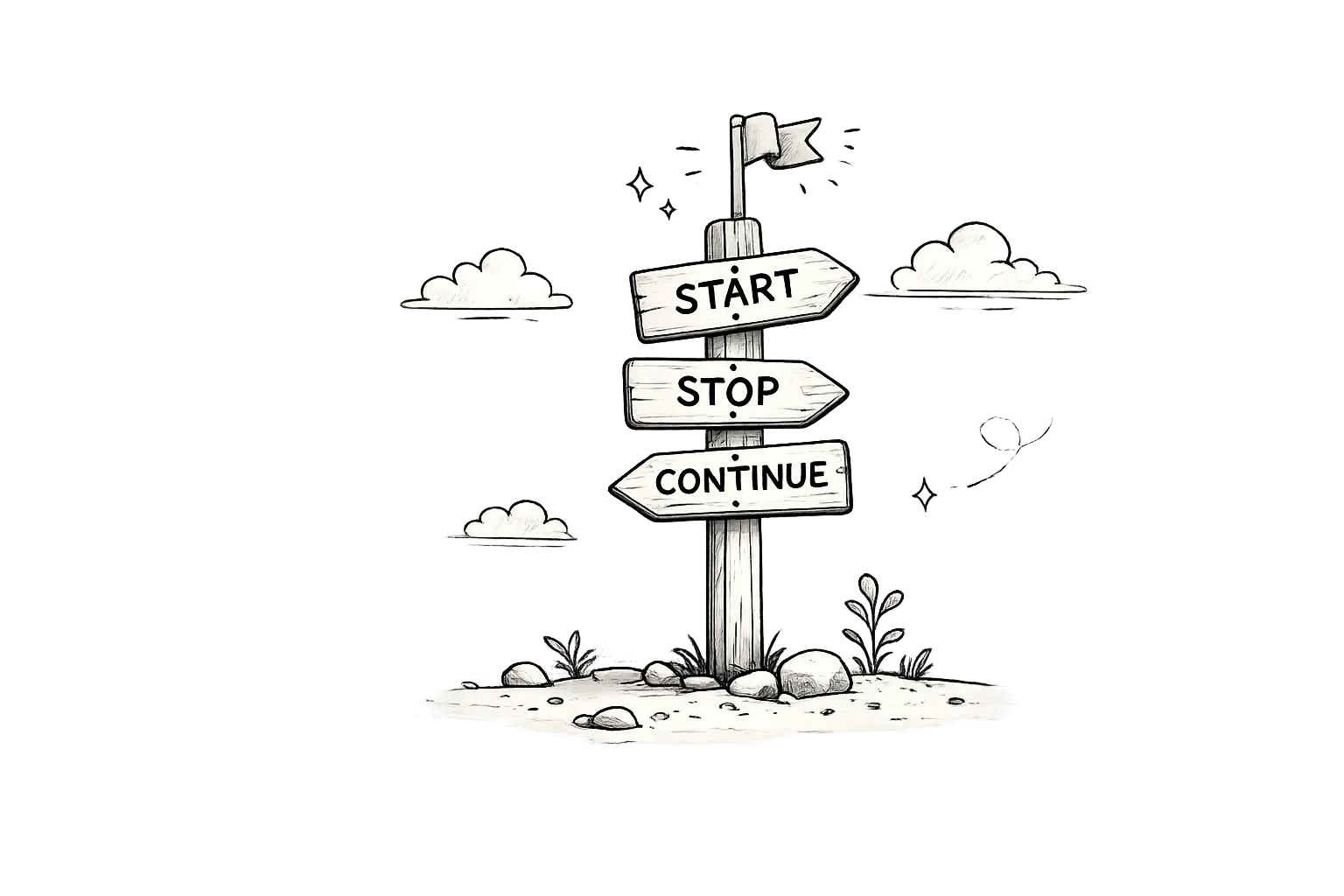
Start/Stop/Continue
A classic three-column retro format that helps teams identify new practices to adopt, unhelpful habits to drop, and winning behaviors to reinforce.

4Ls
A structured four-column retro format — Liked, Learned, Lacked, Longed For — that balances positive reinforcement with honest improvement areas.

Sailboat
A metaphorical retro format where the team is a sailboat — Anchors hold you back, Wind pushes you forward, and Rocks are risks to navigate around.

Mountain Climb
A forward-looking retrospective format that helps goal-oriented teams reflect on progress, identify blockers, and plan the next sprint like climbing a mountain.
Frequently asked questions
What is a DAKI retrospective?
DAKI stands for Drop, Add, Keep, Improve. It's a four-column retrospective format that combines Start/Stop/Continue simplicity with granular improvement tracking.
How is DAKI different from Start/Stop/Continue?
DAKI splits Start into Add, and adds Improve for refining existing practices. It's better for mature teams that need granularity beyond binary start/stop decisions.
How long should a DAKI retro take?
20–30 minutes. The four columns need more time than Start/Stop/Continue but produce more actionable output.
Is DAKI good for remote teams?
Yes — LetRetro's async DAKI board lets team members contribute to all four columns asynchronously, with real-time discussion for top-voted items.
What if a team has nothing to Improve?
Every team has something to improve. If the team can't find any improvement items, it may be stuck in a comfort zone — consider switching to Sailboat or 4Ls for fresh perspective.
Can AI help with DAKI?
LetRetro's AI identifies patterns in Drop items (recurring waste), tracks Add completion rates, and generates improvement trend reports across sprints.
Run your daki retro
Free forever plan. Start running better retrospectives in under 2 minutes.
Get Started Free