5 Best AI Retrospective Tools in 2026
Discover the best AI retrospective tools in 2026. Compare features, pricing, integrations, and free plans to find the right retrospective tool for your team.
Most retrospectives end with a board full of feedback and very little actually changes.
letRetro uses AI to turn that feedback into insights, action items, and real engineering work across Jira, GitHub, GitLab, Linear, Slack, Notion, and MCP-powered developer workflows.
If your goal is to make retrospectives actually improve how your engineering team works, letRetro is built for that.
| Tool | Best for | AI capabilities | Integrations | Free option | Trial |
|---|---|---|---|---|---|
| letRetro | Engineering teams & developer workflows | AI insights, feedback clustering, summaries, action items, sentiment & trend analysis | Jira, GitHub, GitLab, Linear, Slack, Notion & MCP | Free forever | Yes |
| TeamRetro | Team health & Agile coaching | AI grouping, action suggestions, summaries, sentiment & AI assistant | Jira, GitHub, Slack, Azure DevOps, Zapier & more | Trial | 30 days |
| Parabol | Distributed Agile teams | AI grouping, discussion prompts, summaries & related discussions | Jira, GitHub, GitLab, Linear, Slack, Teams & more | yes | Free plan |
| Echometer | Team health analytics | AI-assisted insights, suggestions & action creation | Jira & more | yes | Free option |
| ScatterSpoke | Engineering feedback insights | AI summaries, themes, clustering, trends & feedback analysis | Slack, Microsoft Teams, email, API/MCP & more | yes | Free plan |
If your team wants more than a digital retrospective board, letRetro connects AI-powered feedback analysis with the tools where your team actually works. Turn retrospective feedback into actionable improvements and connect those actions with Jira, GitHub, GitLab, Linear, Slack, Notion, and MCP-powered developer workflows.
Start your first retrospective free →
letRetro — Best AI Retrospective Tool for Engineering Teams
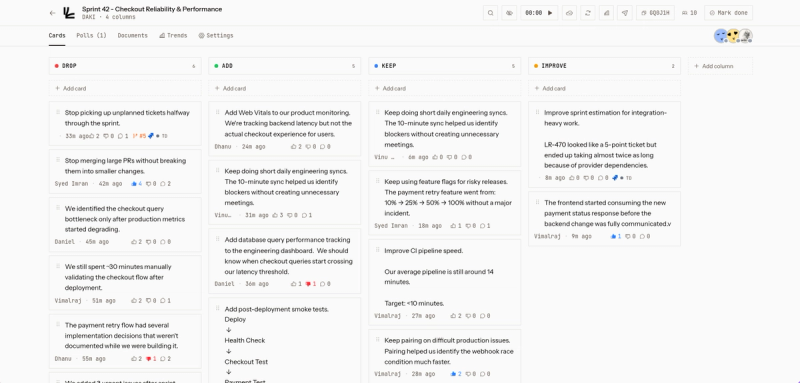
Best for
Engineering teams, Scrum teams, startups, and Agile organizations that want to turn retrospective feedback into real development work.
If your team lives in Jira, GitHub, GitLab, Linear, Slack, or AI-powered developer tools, letRetro is built around the way your team already works.
At a glance
letRetro takes retrospectives beyond the traditional "collect feedback, vote, discuss, forget" workflow.
Its AI can help teams cluster feedback, identify themes, analyze sentiment, generate summaries, draft action items, and uncover trends across retrospectives.
But the real value comes after the analysis.
Teams can turn decisions from a retrospective into owned and trackable actions and connect them with development workflows such as Jira, GitHub, GitLab, and Linear.
That creates a much more useful feedback loop:
Feedback → AI insights → Decisions → Action items → Development work → Follow-up
letRetro also supports modern AI developer workflows through MCP, allowing compatible AI clients and tools to interact with retrospective data.
If your goal is simply to run a retrospective, there are plenty of options.
If your goal is to make retrospectives actually change the way your engineering team works, that's where letRetro becomes particularly interesting.
Free option
Yes — free forever.
letRetro currently offers a free plan with:
- 3 boards
- 1 team
- 20 pooled seats
- 1 canvas
- 2 AI documents per month
- 5 exports per month
The Pro plan currently starts at $15/month and adds significantly higher limits, unlimited boards and teams, more AI usage, trend analysis, MCP requests, integrations, unlimited exports, custom templates, and priority support.
This makes it easy for a small team to start without waiting for a procurement process or committing to an expensive annual contract.
Try it free
Start free. No credit card required.
You can run your first retrospective, bring your team in, explore the AI capabilities, and decide whether it fits your workflow before paying.
Start your first retro free →
Our verdict
letRetro is our top pick for engineering teams looking for an AI-powered retrospective platform.
Its biggest advantage isn't simply having AI.
It's the combination of AI analysis + action tracking + engineering integrations + developer workflows.
For teams using Jira, GitHub, GitLab, Linear, Slack, and modern AI development tools, letRetro can turn the retrospective from a meeting into part of the actual engineering improvement cycle.
Choose letRetro if you want your retrospective insights to lead somewhere — not just sit on a board after the meeting ends.
TeamRetro — Best for Team Health
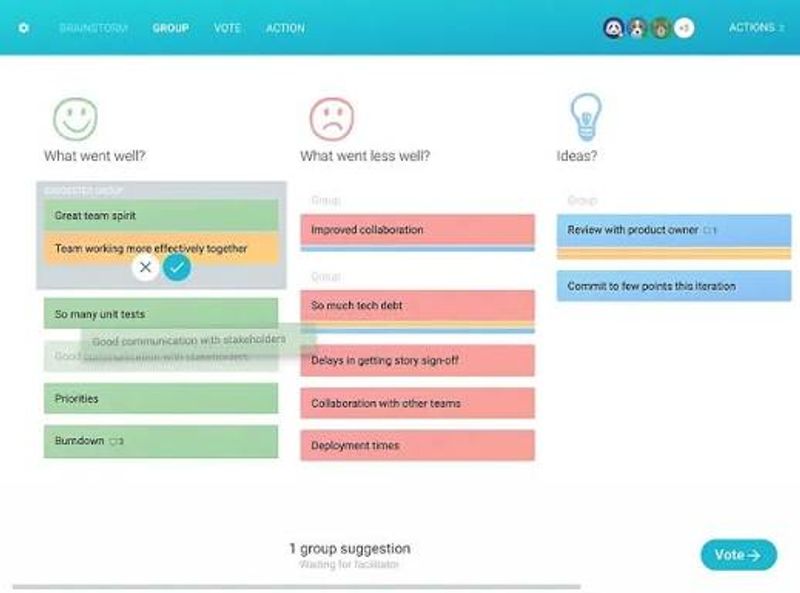
Best for
Agile coaches, Scrum Masters, and teams that want to combine retrospectives with team-health measurement and continuous improvement.
At a glance
TeamRetro is designed for teams that want more structure around their retrospective and team-development process.
Beyond standard retrospective boards, it provides capabilities around team health, Agile maturity, action tracking, analytics, estimation, and AI-assisted facilitation.
Its AI features can help with grouping feedback, suggesting actions, creating summaries, generating templates, and analyzing team sentiment and topics.
For Agile coaches managing multiple teams, this broader approach can be valuable.
Free option
No permanent free plan.
TeamRetro currently provides a free trial, allowing teams to evaluate the platform before committing to a paid plan.
Try it free
30-day free trial.
This gives teams enough time to run multiple retrospectives and evaluate whether the platform fits their existing Agile process.
Our verdict
TeamRetro is a strong choice for teams where team health and structured Agile coaching are just as important as the retrospective itself.
Choose TeamRetro if your organization needs deeper team-health measurement, Agile maturity tracking, and structured facilitation.
Parabol — Best for Distributed Agile Teams
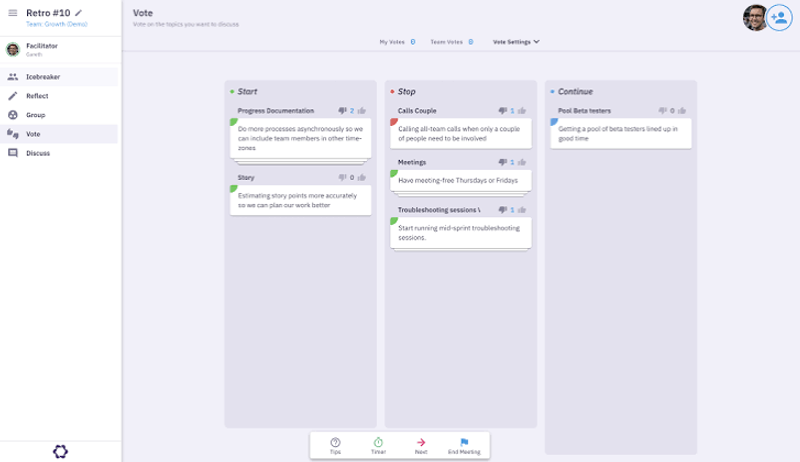
Best for
Remote teams, distributed Agile teams, and organizations that want retrospectives alongside other Agile ceremonies.
At a glance
Parabol takes a broader approach to Agile collaboration.
Instead of focusing exclusively on retrospectives, it brings together retrospectives, sprint planning, estimation, standups, check-ins, and other team meetings.
Its AI capabilities can assist with discussion prompts, grouping, related discussions, and meeting summaries.
For distributed teams, having these workflows together can reduce the number of tools needed to manage recurring Agile ceremonies.
The result is a platform that feels less like a standalone retrospective board and more like an Agile meeting workspace.
Free option
Yes.
Parabol provides a free plan, making it possible for teams to start using the platform without immediately moving to a paid subscription.
Try it free
Start with the free plan.
This makes Parabol a good option for smaller teams and organizations that want to experiment with a broader Agile meeting platform before upgrading.
Our verdict
Parabol is a strong option for distributed teams that need more than retrospectives.
If your team wants retrospectives, planning, standups, check-ins, and other Agile ceremonies in one place, Parabol is worth considering.
Echometer — Best for Team Health Analytics
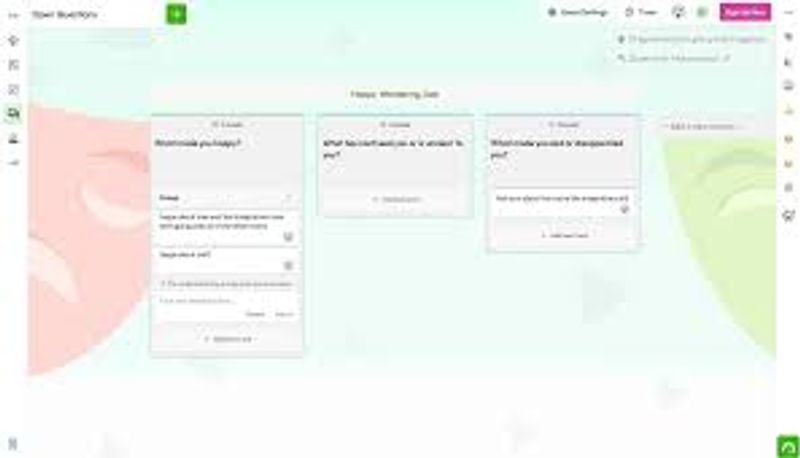
Best for
Teams that want to measure team health and understand whether their continuous-improvement efforts are actually working.
At a glance
Echometer combines retrospectives with team-health checks, pulse surveys, dashboards, action tracking, and longitudinal insights.
That makes its approach different from tools focused primarily on the retrospective meeting itself.
The platform helps teams look at patterns over time rather than treating every sprint as an isolated event.
For example, a team might notice that communication repeatedly appears as a problem across several retrospectives.
Instead of relying on memory, teams can use historical feedback and health data to identify whether the issue is improving or continuing to affect the team.
Echometer also provides AI-assisted retrospective capabilities, helping teams generate ideas and actions during the process.
Free option
Yes.
Echometer provides a free option for teams that want to get started with retrospectives and team-health workflows.
Try it free
Start with the free option.
Teams can experience the retrospective and team-health workflows before deciding whether they need additional capabilities from a paid plan.
Our verdict
Echometer is a good choice when measuring team health is a core part of your retrospective process.
Choose Echometer if your team wants to answer a question that many retrospective tools don't emphasize enough:
ScatterSpoke — Best for Engineering Feedback Insights
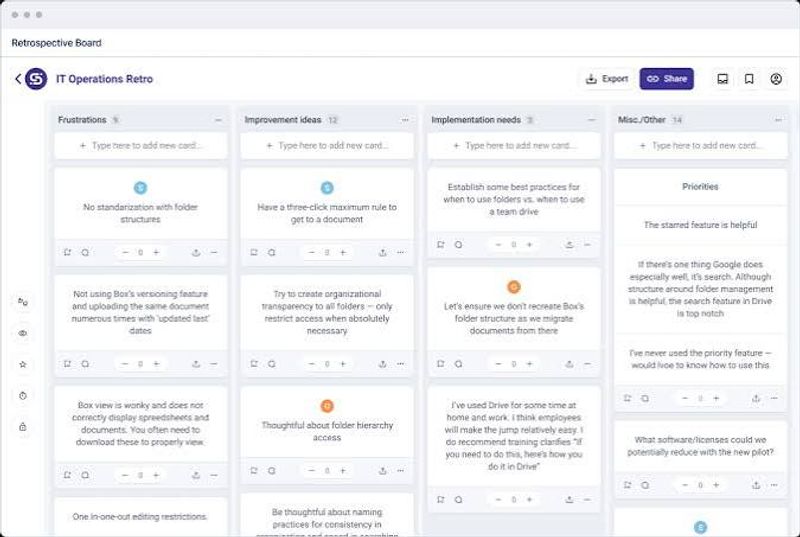
Best for
Engineering organizations that want to analyze feedback across retrospectives and other engineering feedback channels.
At a glance
ScatterSpoke approaches retrospectives from a broader feedback-intelligence perspective.
Instead of limiting analysis to what happens during a retrospective, it can help engineering organizations analyze feedback from multiple sources and identify themes, trends, issues, and patterns.
Its AI capabilities include feedback clustering, summaries, theme analysis, trend detection, and natural-language interaction with feedback data.
This can be particularly useful for engineering leaders who want to understand not just what happened during the last retro, but what keeps happening across teams and over time.
Free option
Yes.
ScatterSpoke provides a free starting option, allowing teams to explore its feedback and AI capabilities.
Try it free
Start with the free plan.
This makes it possible to evaluate the platform before moving to a paid plan.
Our verdict
ScatterSpoke is an interesting choice for engineering organizations that want to go beyond traditional retrospectives and analyze feedback more broadly.
About the author

Marketing @letRetro
Arun is a marketer at letRetro, passionate about understanding users and crafting stories that connect people with products. He thrives at the intersection of product, community, and growth. Beyond work, he's the team's trip planner and the cricketer who never misses a chance to get everyone on the field.
View all articles